Bibliographie financière - Ouvrages en cours ou en attente de lecture
The analysis reported here is a continuation of a study begun at the end of 1927 and originally published in 1933 (1). At that time were reported the results achieved by 24 financial publications in forecasting the course of the stock market during the period from January, 1928, to June, 1932. This earlier investigation disclosed no evidence of skill in forecasting. The present study extends the records of 11 of the forecasters. In the case of 7 of these the record now covers the 15,5 years from January, 1928, to July, 1943, and, for the remaining 4, periods of about 11 years ending in 1938 or 1939. The forecasters include 4 financial periodicals and 7 financial services. These organizations are well known. Names are omitted here because their publication might precipitate controversy over interpretation of the records. The wording of many of the forecaster after the event to present a plausible argument in favor of an interpretation other than the one made by a reader. The methods used in this analysis was for each of two readers (2) to grade the forecasts independently according to the degree of bullishness or bearishness which he though they contained. The average of the two interpretations was used as the basis for computing the record. It was assumed that the reader, if the forecast was 100-per-cent bullish, would invest all of his funds in the stock market; if the forecast was 50 per-cent bullish, he would put three-quarters of his funds in stocks; il 50-per-cent bearish, one-quarter in stocks; ansd if 100-per-cent bearish, nothing in stocks. The forecasts thus tabulated have been tested in the light of the fluctuations of the stock market as reflected by the Standard & Poor's average of 90 representative common stocks. If the forecast is 100-per-cent bullish and the market rises 10 per cent, the forecasting score is 1.10. If the forecaster is doubtful, the score is 1.05, reflecting one-half of the market advance, on the assumption that the investor, being doubtful, would place one-half of his funds in stocks and hold one-half in reserve. If the forecast is 100-per-cent bearish, the score is 1.0, regardless of the subsequent action of the market, on the assumption that the investor would have withdrawn all of his funds from the market. If the forecast is 100-per-cent bullish, and the market drops 10 per cent, the score is 0.90, and if the forecast is doubtful and the market drops 10 per cent, the score is 0.95. The compounding of the weekly scores for each agency gives its forecasting record for the whole period. These results are compared with a figure representing the average of all possible forecasting results, arrived at by compounding one half of the percentage change in the level of the stock market for each period, wich hereafter for convenience will be referred to as the "random forecasting record." The results presented, hereafter called the "index of performance," are derived by dividing the actual compounded record of each forecaster by the random forecasting record referred to above and substracting 1. The results have also been decompounded so as to represent an effective annual rate. If a forecaster's record is plus it is better, and if minus il is worse, than the random forecasting record. Most of the agencies published forecasts every week and these were tabulated on a weekly basis. In other cases the latest forecast was assumed to be in effect until the next one appeared.
The process described above may be expressed in algebraie terms as follows :
Let t = date, measured in weeks;
pt = actual market (Standard & Poor's index of 90 stocks) at date t;
 |
increase or decrease (rate) in actual market from date t to date t+1 ; |
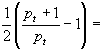 |
increase or decrease (rate) in "random forecasting record," that is, one-half increase or decrease in actual market; |
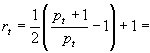 |
ratio of random forecasting record at date t+1 to random forecasting record at date t; |
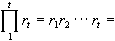 |
compounded random forecasting record at date t+1; |
| qt = | fraction of funds kept in market on advice of forecaster from date t to date t+1; |
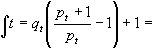 |
ratio of value of above investment (including idle cash) at date t+1 to value at date t; |
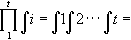 |
compounded value of investment at date t+1; |
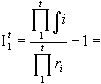 |
"index of performance" of forecaster from date 1 to date t+1 that is, ratio of coumpounded value of investment to compounded random forecasting record; |
Work sheets for the computation have the form shown in Table 1 (using hypothetical values and working to only 2 decimals as compared with 4 used in the actual study) :
| TABLE 1 | ||||||||
| 1 | 2 | 3 | 4 | 5 | 6 | 7 | 8 | 9 |
| Weeks | Actual Market |
Rate of increase or decrease in actual market |
Ratio of random fore- casting record at t+1 to that at t |
Com- pounded random fore- casting record |
Forecaster A | |||
| Frac- tion of funds in market |
Ratio of value at t+1 to that at t |
Com- pounded value |
Index of perfor- mance |
|||||
| t | pt |  |
rt |  |
qt |  |
 |
 |
| 1 2 3 4 5 6 |
50 60 75 75 60 54 |
+0.20 +0.25 0 -0.20 -0.10 |
1.10 1.12 1.00 0.90 0.95 |
1.10 1.23 1.23 1.11 1.05 |
1.00 0 0.50 1.00 0.50 |
1.20 1.00 1.00 0.80 0.95 |
1.20 1.20 1.20 0.96 0.91 |
+0.09 -0.02 -0.02 -0.14 -0.14 |
Thus the hypothetical forecaster was better than the random forecasting record in the first week because he had 100 per cent of his funds in the market instead of only 50 per cent; in the second week he lost by staying out of a rising market; in the third week the market did not move and he just held his own (which he would have done regardless of his position in the market); in the fourth week he lost by being bullish in a bear market; and in the fifth week he lost but maintained the same relation to the random forecasting record as the week before.
Figure 1 indicates that 6 of the 11 forecasters met with some degree of success and that 5 were unsuccessful in their forecasts. The 11 forecasters were on the average only 0.2 per cent a year better than the random forecasting record.
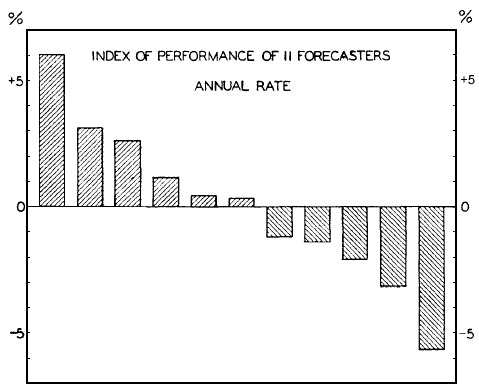
That one of the forecasters had an average annual rate 6.02 per cent better than the random forecasting record is to be discounted by the fact that it is the best of the 11 records examined. Assuming a complete lack of ability, if one had the opportunity to make 11 attempts, the best of these by chance might show a considerable degree of success. In this analysis, the least successful of the forecsters, with an average annual rate 5.62 per cent worse than the random forecasting record, was wrong almost as much as the most successful one was right.
Figure 2 depicts the result of dividing the 15,5 year period into 17 major swings and for each of these computing the average index of performance; that is, the average result of the 11 forecasters (3) as a percentage of the random forecasting record. Any rise exceeding 33 per cent, or decline of more than 25 per cent, was designated as a major swing, the daily highs or lows being considered rather than weekly or monthly averages. The last swing was arbitrarily terminated in July, 1943, because when the analysis was made the market in that month has reached its highest point since the low of 1942, and subsequent to July 1943, it had not declined as much as the 25 per cent necessary to establish a major down-swing. It appears that the consensus of opinion was always right in the case of bull markets, and wrong in the bear markets. Of the 6904 forecasts recorded, 4712 were bullish, 1107 doubtful, and 1085 bearish. Yet only 88 months of the period are occupied by bull markets and 98 by bear markets, and in July, 1943, the end of the 15,5-year period, the market was at only about two-thirds of its level at the beginning of this period in January, 1928. In the case of every one of the 11 forecasters the number of bullish predictions far exceedeed the number of bearish ones. The persistent and unwarranted record of optimism can possibly be explained on the ground that readers prefer good news to bad, and that a forecaster who presents a cheerful point of view thereby attracts a following without which he would probably be unable to remain long in the business of forecasting. In extenuation, however, it may be said that the last 15 years is the longest period on record in wich the industrial stock averages failed to move into new high ground. During the 57 years from 1871 to 1927, the average rate of gain for industrial common stocks in the United States was 3.8 per cent a year in addition to dividend income, and the longest period in which a previous all-time high was not exceeded was 9,75 years from June, 1889, to MArch 1899. This background may have exerted a strong influence during the last 15 years on the minds of the forecasters.
It was found possible to extent back to 1903 the published record of the forecasting agency with the most successful record for the period from 1928 to 1943. While three individuals were for different periods responsible for the forecasts throughout those 40 years, the general principles followed by them all were similar and the succeeding forcasters were avowed disciples of their predecessors. It therefore seems justifiable to treat the combined record as a continuous one for the 40 years in question. In analyzing this record, the same method was used as in the case of the 11 forecasters previously reported except that corrections were made ton include cash dividends, brokerage charges, and interest which could have been earned on idle funds. Also, the Dow-Jones industrial average (4) was used
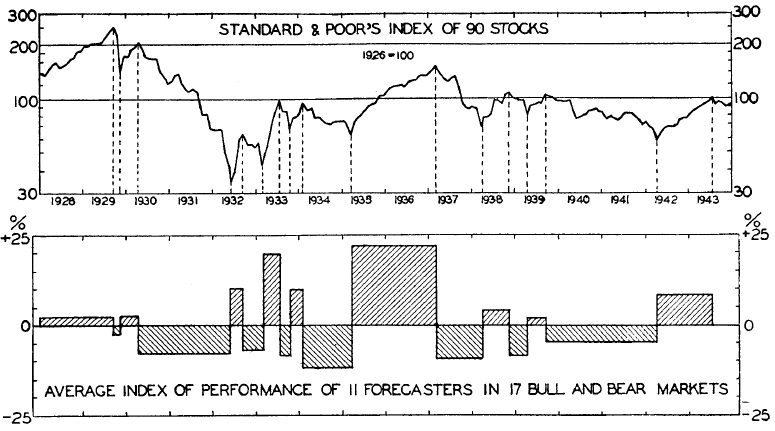
Figure 2 - The index of performance in this case is the per cent by witch the average of the compounded records of all forecasters is better or worse than the random forecasting record for each of the 17 major swings. The curve int the upper half of the charts shows the monthly averages of Standard & Poor's Index of 90 stocks except at terminations of bull markets where the highest of the daily averages are shown, and at terminations of bear markets where the lowest of the daily averages are given.
in computing the market gain or loss on each forecast instead of the Standard & Poor's average of 90 stocks since the latter is not available prior to 1926. The resulting figure was reduced to the actual effective annual rate of gain instead of to the index of performance. The rate of gain computed as above indicated is 14.2 per cent a year, of wich about 4.2 per cent is dividend and interest income. In the same period a continuous investment in the stocks composing the Dow-Jones industrial average would have shown a return, including dividends, of 10.9 per cent a year. Following the forecasts, therefore, would have resulted in a gain of 3.3 per cent a year over the result secured by a continuous investment in the common stocks composing the Dow-Jones industrial average.
Breaking the record down into four periods of 10 years each, we find that following the forecasts would have shown an average annual capital gain of about 13 per cent from 1904 to 1913, 7 per cent from 1914 to 1923, 13 per cent from 1924 to 1933, and 7 per cent from 1934 to 1943. This is without including the cash dividends and interest earned on idle funds which would have averaged around 4.2 per cent a year. There were two fairly long periods in wich following the forecasts would not have resulted in profits. One of these was the 5.5 years from the fall of 1909 to the spring of 1915 when losses averaging about 3 per cent a year would have been incurred. The other was the last 6 years of the record from June, 1937, to June, 1943, when little if any profit would have been secured. Both of these were, however, periods in wich stock prices were lower at the end than at the beginning, so that following the forecasts would not have been less successful than a continuous investment in common stocks.
In view of this moderately but consistently successful result over such a long period it may be of interest to consider the forecasting method used and some statistical evidence as to the soundness of the principles involved. The theory of these forecasters was that there was a prevalence of sequences over reversals in the movements of stock prices (5) and that it was, therefore, desirable to swim with the tide. They evolved various devices for recognizing when the tide had turned, no attempt being made to anticipate such an event. The magnitude of the cycles to be identified apparently was of several years' duration and particular significance generally was not attached to developments requiring less than a few weeks to materialize. A detailed discussion of the statistical devices employed in the forecasts will not be attempted here because the forecasters never reduced their method to terms which could be defined precisely in a mathematical sense or wich made possible its application by two independant operators with any assurance of securing identical, or at least similar, results. It will suffice to say that they tried to recognize when the long-term trend of the market had reversed itself simply by the superficial appearance of the general pattern presented rather than by any precise statistical test.
What statistical evidence is there as to why such an apparently naive procedure should be successful ? The author and the late Herbert E. Jones once made an investigation of the evidence as to the Element of inertia in stock prices as follows : (6) In a penny-tossing series there is a probability of one-half that a reversal will occur. If the stock market rises for one hour, day, week, month, or year, is there a probability of one-half that it will decline in the succeeding comparable unit of time ? In a attempt to answer this question, sequences and reversals, as defined in footnote 5, were counted.
A study of the rationof sequences to reversals will probably disclose structure as previously defined, if it exists within the series, and the significance of this structure can be investigated by ordinary statistical methods. For instance, the probability can be dertermined that any ratio occurred by chance, from a random population of possible price series. Also, from the frequency distribution of these ratios one can estimate the probabilities of success in forecasting a rise or decline in stock prices. Samples of adequate length, were available, were examined, the intervals between observations being successively 20 minutes, 1 hour, 1 day, 1, 2, and 3 weeks, 1, 2, 3, ... , 11 months and 1, 2, 3, ... , 10 years. It was found that for every series with intervals between observations of from 20 minutes up to and including 3 years, the sequences outnumbered the reversals. As a result of various considerations it appeared that a unit of 1 month was the most promising from a forecasting viewpoint. In the case of the 100-year monthly series of common-stock prices from 1836 to 1935, a total of 1200 observations, there were 748 sequences and 450 reversals. That is, the estilmated probability was 0.625 that, if the market had risen in any given month, it would rise in the succeeding month or, if it had fallen, that it would continue to decline for another month. The standard deviation for such a long series constructed by random penny tossing would be 17.3 ; therefore the deviation of 149 from the expected value 599 is in excess of 8 times the standard deviation. The probability of obtaining such a result in a penny-tossing series is infinitesimal.
An investigation of the average amount the stock market moved in each month, a consideration of brokerage costs, and determination of the degree of consistency revealed by the data, were used to supplement the information as to the ratio of sequences to reversals. This further analysis indicated an average net gain of 6.7 per cent a year with a probability of a net loss in 1 year out of 3. To this should be added the expected dividend and interest income which for the period analyzed would have been about 5 per cent a year. The anticipated degree of success in forecasting should be modified by a consideration of the fact that the unit of time employed, 1 month, was selected by hindsight after investigation of various other possible units of time. The investigation, however, discloses evidence of structure in stock prices sufficient to account in large measure for the success of the 40-year forecasting record herewith reported.
CONCLUSION
(1) The records of 11 leading financial periodicals and services since 1927, over periods varying from 10 to 15.5 years, fail to diselose evidence of ability to predict successfully the future course of the stock market.
(2) Of the 6904 forecasts recorded during the 15.5 year period, more than four times as many were bullish as bearish, although more than half of the period was occupied by bear markets, and stocks, at the end were at only about two-thirds of their level at the beginning.
(3) The record of the forecasting agency with the best results for the 15,5 years since 1927, when tabulated back to 1903, for the 40 years showed results 3.3 per cent a year better than would have been secured by a continuous investment in the stocks composing the Dow-Jones industrial average. Under present laws the capital-gains tax might wipe out most of this advantage. While prospects for the speculator are, therefore, not particularly alluring, statistical tests disclose positive evidence of structure in stocks prices wich indicates a likehood that whatever success may be claimed for the very consistent 40-year record is not entirely accidental. A simple application of the 'inertia' principle, such as buying at turning points in the market after prices for a month averaged higher, and selling after they averaged lower, than for the previous month, would have resulted in substantial gains for the period under consideration.
Cowles Commission for Research in Economics
The University of Chicago
(*) Cowles Commission Papers, New Series, No. 6.
(1) "Can Stock Market Forecasters Forecast ?" by Alfred Cowles, ECONOMETRICA, Vol. 1, July, 1933, pp. 309-324
(2) The author is indebted to Dickson H. Leavens, Forrest Danson, and Miss Emma Manning of the Cowles Commission for Research in Economics, The University of Chicago, for assistance in tabulating the forecasts and computing the records.
(3) For the period subsequent to 1939 only 7 of the 11 forecasting records were available.
(4) Where needed in order to preserve the continuity of this average, corrections were made to offset the effect of stock dividends and changes in the list of stocks included.
(5) The word "sequence" is used here to denote when a rise follows a rise, or a decline a decline. A "reversal" is when a decline follows a rise, or a rise a decline.
(6) "Some A Posteriori Probabilities in Stock Market Action," by Alfred Cowles and Herbert E. Jones, ECONOMETRICA, Vol. 5, July, 1937, pp. 280-294.
 Retour au sommaire du site
Retour au sommaire des backtest
Retour au backtest 'conseils'
Retour en haut de la page
Retour au sommaire du site
Retour au sommaire des backtest
Retour au backtest 'conseils'
Retour en haut de la page
Rubriques
Meilleurs courtiers en Bourse
Meilleurs PEA
Toutes les données du CAC40
Livres finance et Bourse
Newsletter
Pour recevoir nos derniers articles, détachements de dividendes et offres de placements :
Nous contacter ou nous suivre sur les réseaux
Site hébergé par OVH - 2 rue Kellermann - 59100 Roubaix - France - Tel : 09 72 10 10 10