The Inefficient Stock Market, what pays off and why
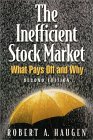

4ème de couverture
Robert A. Haugen is Emeritus Professor of Finance at the University of California, Irvine. Professor Haugen has held endowed chairs at the University of Wisconsin, the University of Illinois, and the University of California. He is the author of more than 50 articles in the leading journals in finance and 13 books, including The incredible January Effect, The New Finance, Beast on Wall Street, and Modern Investment Theory. He serves as Managing Partner to Haugen Custom Financial Systems, which licenses portfolio management software to 25 pension funds, endowments, and institutional and high-net-worth money managers. Visit Robert Haugen's Web site at www.bobhaugen.com.
Préface
Factor models have been widely employed in the investments business for decades. Quantitatively oriented managers have used them to control the month-to-month variation in the differences between the returns to their stock portfolios and the returns to the stock indices to which they are benchmarked. These models employ a wide variety of ad hoc factors that have been shown to be effective in predicting the risk of a stock portfolio.
Factor models have also been widely discussed in academic finance. Finance professors have long searched for the factors that account for the extent to wich returns are correlated stock to stock. The proffesors have correctly concluded that the correlations can be explained by a few factors, such as unexpected changes in industrial production, inflation, or interest rates. This is not to say that these few factors can match the success of the wide variety of ad hoc factors used in the business for forecasting risk.
The professors have also used factor models to explain why stocks have differential expected returns. These models are theoretical in nature, and are derived under the assumption that pricing in the stock market is efficient and rational. If it is not, a wide variety of ad hoc factors may be useful in explaining and predicting expected stock returns.
Until recently, ad hoc factor models have not been employed to predict the expected return to stock portfolios. Surprinsingly, the factor models are much more powerful in predicting expected return than they are in predicting risk. The purpose of this book is to demonstrate and explain the nature of this power.
I wish to thank Teimur Abasov, David Friese, and David Olson for research assistance. I have also benefited from the comments of Mark Fedenia, Joseph Finnerty, Jeremy Gold, Tiffany Haugen, Thomas Krueger, Robert Marchesi, Cheryl McCaughey, Ray Parker, Neal Stoughton, Manuel Tarrazo, and Ole Jakob Wold. Much of the original work was done jointly with Nardin Baker. The idea for this book was suggested to me by Paul Donnelly.
Introduction
BRAINWASHED
For the past 40 years, a total of aproximately one million unsuspecting MBA students have been thoroughly indoctrinated by business schools with the belief that stock markets are efficient.
An efficient market always prices every stock correctly. That is, the price of each stock accurately reflects the very best estimate of all the dividends and the price established by the efficient market, you can expect to earn a return on the stock that is perfectly fair, given the stock's relative risk and the returns that are available elsewhere in the financial markets.
True advocates of efficient markets believe this is the case at all times and for every stock.
If it is true, you can pick stocks by throwing darts. But forget darts ! Your best investment is really a simple index fund--a fund that invests in a broad market index like the S&P 500.
Think stocks are too risky ? Then lower your risk by putting a sufficient amount of your money in the bank instead of in the index fund. You see, risk management is really easy in an efficient market.
Trying to smooth the earnings of your company through accounting adjustments ? You're simply wasting your time ! The efficient market sees right through the numbers you report--it knows the real numbers, so you might as well report them in the first place.
Delaying making a business investment because you think interest rates are too high ? Another mistake ! Interest rates are never too high. They always reflect the best possible estimate of future inflation as well as a fair level of compensation to bondholders for consuming later so that you can invest now.
By the way, it makes no difference whether you finance that investment by selling bonds or stock. The efficient market prices both fairly. In fact, if you raise money by selling any type of financial claim on the profits of your firm, given its best estimate of your firm's future profits and given it sound analysis of the nature of the claim, the efficient market will price it fairly. So go ahead. Issue a few AA debentures--or a lot of junk bonds. Make them convertible, callable, zero coupon, etc. The efficient market will assign any or all a price that is correct and fair. The total value of your firm will be unaffected no matter what you do1.
Pretty heady stuff.
If the market is efficient, the world turns into a pretty simple place--at least for the people in academic finance.
However, don't throw away all those investment and business books you've collected over the years.
Because it's not.
Efficient, that is.
Although efficient markets people still go around saying there is a "mountain" of evidence supporting their hypothesis, the truth of the matter is that it's a very old mountain that's eroding rapidly into the sea.
A new and growing mountain of evidence is completely contradictory to the notion of efficient markets.
And contradictory in a big way. It's now very clear that the market makes BIG mistakes in pricing stocks. It doesn't see through reporting accounting numbers. It's typically overly optimistic about to-be-reported earnings2. It projects that successful firms will continue their success for far too long into the future3.
And the list goes on and on.
And what about the one million MBAs who went to business school to learn about investing and running a business ?
They should ask for their money back.
THE EVOLUTION OF ACADEMIC FINANCE
As a rather ancient ex-academic, I like to distinguish between The Old Finance, Modern Finance, and The New Finance.
Figure 1-1 summarizes their basic features. The top of the figure shows the time frame over which each existed.
See the blocked-off period during the 1960s ? This is when I received my formal education in finance. Note that I went to school when Modern Finance was relatively young and when The Old Finance was dying.
An interesting time indeed.
My professors, groomed in The Old Finance, were mostly expert in the fields of accounting and law. In fact, accounting and law are the basic foundations of The Old Finance.
Of all the books I was asked to master, two stand out clearly in my mind.
The first was called Security Analysis4. It was written by Benjamin Graham and David Dodd, and we used it to study investments. Graham and Dodd spent most of their book showing us the painful process of adjusting accounting statements so that the earnings and assets of different companies could be directly compared.
| FIGURE 1-1 The evolution of Academic Finance | |||||||||||||||||||||||||||||||||||
|
|||||||||||||||||||||||||||||||||||
| The Old Finance | |||||||||||||||||||||||||||||||||||
| Theme : | Analysis of Financial Statements and The Nature of Financial Claims | ||||||||||||||||||||||||||||||||||
| Paradigms : | Analysis of Financial Statements (Graham & Dodd) - Uses and Rights of Financial Claims (Dewing) | ||||||||||||||||||||||||||||||||||
| Foundation : | Accounting and Law | ||||||||||||||||||||||||||||||||||
| Modern Finance | |||||||||||||||||||||||||||||||||||
| Theme : | Valuation Based on Rational Economic Behavior | ||||||||||||||||||||||||||||||||||
| Paradigms : | Optimization (Markowitz) - Irrelevance (Modigliani & Miller) - CAPM (Sharpe, Lintner & Mossen) - EMH (Fama) | ||||||||||||||||||||||||||||||||||
| Foundation : | Financial Economics | ||||||||||||||||||||||||||||||||||
| The New Finance | |||||||||||||||||||||||||||||||||||
| Theme : | Inefficient Markets | ||||||||||||||||||||||||||||||||||
| Paradigms : | Inductive ad hoc Factor Models Expected Return (Haugen) - Risk (Chen, Roll & Ross) - Behavioral Models (Kahneman & Tversky) | ||||||||||||||||||||||||||||||||||
| Foundation : | Statistics, Econometrics, and Psychology | ||||||||||||||||||||||||||||||||||
This was mostly very dry stuff and not too interesting.
But, to their credit, our professors taught us a craft. We learned what to watch out for in accounting statements and how to make the proper adjustments. Useful stuff.
The second book was called The Financial Policy of Corporations5. It was written in two great volumes by Arthur Stone Dewing. This book made Security Analysis look like a Stephen King thriller. In Policy, we learned the legal rights of financial claims--in great details. We learned the laws relating to merger and acquisition as well as those governing bankruptcy and reorganization.
Once again, our professors were teaching us as craft. We were preparing for our future. As possible future financial executives, we needed to know the rules of the game if we had to merge or go bust, as well as the legal impediments on our firm's behavior created by the financial claims that were today or might be there tomorrow.
Unbeknownst to me at the time, the birth of Modern Finance occurred when, early in the 1950s, a Ph.D. student named Harry Markowitz created a dazzling new tool for building stock portfolios called portfolio optimization.
Suppose you have a population of stocks, each having a different expected return and a different level of risk6. You want to construct a portfolio of these stocks that has a 10% expected return. Harry showed how much to invest in each stock so as to have the lowest possible variability in periodic return, given our 10% expected return objective.
Although portfolio optimization would ultimately prove to be of great value to the world, Harry's new tool would lie almost unnoticed for more than a decade.
In the middle of that decade, two economists named Modigliani and Miller introduced the second major paradigm of Modern Finance--The M&M Irrelevance Theorems.
What was irrelevant ?
Apparently all the rules and laws we had been studying in Dewing's Policy. M&M claimed that the nature and composition of the right side of a firm's balance sheet--it's financial claims--didn't matter. What did matter was the nature and composition of the left side--it's asset and investments. How you packaged, for delivery to the claimants, the fruits of those investments had no impact whatsoever on the total value of the firm.
Although M&M didn't say so at the time, the Irrelevance Theorems assumed an efficient market. Only if all possible claims are fairly priced will their nature have no impact on firm value7. If you know that your stock is being priced at half its fair value by an inefficient market, issuing more of it to new stockholders will not be in the interests of your existing stockholders.
The third and fourth paradigms of Modern Finance appeared at approximately the same time in the early 1960s.
The Capital Asset Pricing Model (CAPM) assumed universal8 and unrestricted9 use of the Harry Markowitz's optimization tool. If everyone built their stock portfolio by optimizing, how would this affect pricing in the securities market ?
The answer :
Under these conditions, a single factor would make one stock different from another in its expected return. In the world of CAPM, investors hold widely diversified portfolios. In fact, in the simple form of the model, we all invest in the market index. Risk is then variability in return to that index. The risk of an individual stock is measured by its contribution to that variability.
They called this contribution beta--the sensitivity of a security's periodic return to changes in the periodic return to the market index.
The ascension of Modern Finance was complete with the introduction of the fourth paradigm. Interestingly, it came from the same campus as Harry's tool.
Again a Ph.D. student.
Eugene F. Fama dreamed of the efficient market and wrote of it in his dissertation.
Not much in the way of rigorous theory here. Just a contention consistent with some initial empirical evidence. Stock prices appeared to change randomly from one period to the next. If stocks were always responding instantly and accurately to the appearance of new and unanticipated information (which must come in randomly if it truly can't be anticipated), prices would move randomly as well.
All in all, this looked like an impressive set of paradigms at the time.
Impressive, but threatening to my old professors.
Given these paradigms, what good would come from standardizing accounting statements ? The statements had already been "standardized" in the minds of countless investors looking for bargains. These investors had acted. Prices had been set.
To reflect the true level of earnings.
Standardizing accounting statements was now seen as a colossal waste of time. Learning how to do it as well.
And the nature of financial claims was also irrelevant.
The craft of finance and the teachings of my old professor had been rendered obsolete.
It's not nice to be obsolete.
The professors of The Old Finance fought very hard to retain their relevance. The battles of this intellectual war are still recorded in the pages of ancient issues of the journal of finance and the American Economic Review.
But the professors of the Old lost most of these battles, and eventually they lost the war itself.
New professors came to the university. With very different skills. Many came from economics departements, and they had been trained to theorize under the assumption of rational economic behavior.
How would the market behave if emotions or biases never came into play ? How would the market behave if everyone thought through the implications of every decision to the finest detail ?
With initial empirical support for their paradigms and the true triumphs that came with the introduction of models for the pricing of options, Modern Finance took off, seeming to possess the characteristics of a true paradigm shift. It became the dominant discipline in business schools, and it carried great influence in the real world.
Those who would dare to question the validity of the paradigms--especially that of efficient markets-- were summarily dismissed as gauche.
Those who dared to publish papers contradicting the paradigms were ridiculed. Their studies were supposedly replete with bias. And their methods, of course, were presumed naïve.
Their studies included only firms that survived the study period--survival bias. They used earnings numbers that may not have been publicly available at the time they bought the stocks--look-ahead bias. They probably spun the computer countless times until they got an interesting result--data mining. They didn't take transactions costs into account. They didn't risk-adjust their returns. They didn't test for statistical significance. Their results weren't robust in different time periods.
On and on...
However, we now know these initial results were on the mark10.
But summarily dismissed.
Fortunately, even when the mud is thick, truth always makes its way to the surface.
Modern Finance received a real punch in the nose in 1976 in the form of a study out of the University of Iowa11. Roseff and Kinney discovered that January was a very unusual month for the stock market. The returns to an equally weighted stock index were remarkably high in the first month of the year.
Then the results came pouring in.
Most of the premium return came in the first two weeks,12 normally to the smaller stocks.13 The effects was prevalent in most of the stock markets throughout the world.14 Stocks that paid no dividends were particularly affected,15 as were stocks that had been poor performers in the past.16
Modern Finance now faced a myriad of anomalies coming from every direction.
Anomaly : evidence of behavior that contradicts accepted theoretical prediction.
Anomalies : stocks with relatively high current-earnings yields produce high future returns.17 Stocks with relatively high book-to-price ratios also.18 Short-term reversals in stock price movemements. Intermediate-term momentum and longer-term reversals.19 Underreaction to financing through sales of stock20 and to announcements of stock repurchase programs.21
And this is but a short list.
Anomalies : statistically significant, risk-adjusted results, net of transaction costs, which can't be explained on the basis of the bias problems discussed above.
But that's okay. After all, they're only anomalies. Fair warning. Anyone who takes them seriously can expect to be dismissed as gauche.
But alas ! There are too many to be dismissed.
And now Modern Finance begins to teeter.
And a New Finance appears.
Discard those theories that obviously have no predictive power. Discard the requirement that all explanations must be based on rational economic behavior. Look carefully at the data and measure accurately without preconception. Discard the tradition that you must first model without looking and then verify. Carefully measure behavior first, and then find reasonable and plausible explanations for what you see. Ascension of the ad hoc, expected return, factor model. The measure of any model's relative merit : the unmined, out-of-sample, relative accuracy of its predictions.
Go back to teaching students a craft rather than a religion.
The drummers sound, the cannons roar, and a second war begins.
The side that predicts best must ultimately win this war, for the simple reason that the world places great value on accurate prediction.
Students will want to claim that value.
And business school deans will want to satisfy their demands.
The war is long and bitterly fought. Obsolescence is, once again, on the line. The students are coming to the university, once again, to learn the craft of finance.
Unfortunately, many of the "modern" professors haven't learned the craft themselves.
So they must be retooled.
WHY YOU NEED TO READ THIS BOOK
The inefficient market makes many mistakes in pricing stocks. These mistakes result in tendencies. Stocks with particular characteristics tend to produce premium returns.
The market has a map with topography measured in expected return. There are places to go on that map that are evil. If you go there, you will underperform badly in the long run. There are good places, too. Go there and you will be rewarded.
In this book, you will learn how to measure the payoffs to stock characteristics (factors). My book The New Finance: The Case for an Overreactive Stock Market22 is about the positive payoff to cheapness. However, we will also discuss, among other things, the payoffs to risk, liquidity, profitability, and a stock's performance in past periods.
And, in the tradition of The New Finance, we shall seek reasonable explanations for these payoffs. Some of these explanations are consistent with rational behavior. However, the contractual environment in wich this behavior takes place is, itself, irrational, creating agency problems that induce the behavior. Some payoffs are rooted in purely irrational human behavior. For these, we look toward the field of psychology.
You will also discover a new kind of stock.
You've probably heard of growth stocks and value stocks. Both reside at different places on the market's map. But there are other places on the map where few have ever gone.
A Super Stock portfolio has the following characteristics : The companies in the portfolio are, on average, big, liquid, and well-known. They have low risk, and they are financially sound. They are highly profitable in all dimensions. And while they have had strong relative performance over the past year, they are still selling at dirt-cheap prices relative to their cash flow, earnings, and dividends.
This is a dream profile. It is the profile of a portfolio that can be expected to produce the best returns in the future.
No individual stock has the complete profile. If a stock were complete, the inefficient market would price it up until it was expensive rather than cheap.
Nevertheless, it is easy to construct a complete portfolio by assembling incomplete stocks that have components of the complete profile.
Want to learn how to build such a portfolio ?
Want to learn what pays off and why ?
Keep reading.
Notes
1. Technically, even if the market is efficient, your choice between debt and equity may affect your tax bill
because interest payments are deductible while dividend payments are not. Also, the presence of debt may make
you, as manager, do things you wouldn't ordinarily do--like try harder to make enough money to meet the interest
charges.
2. See P. Dechaow and R. Sloan, "Returns to Contrarian Investment Strategies : Tests of Naïve
Expectations Hypotheses," Journal of Financial Economics, 43 (1997).
3. See R.La Porta, J. Lakonishok, A. Shleifer, and R. Vishny, "Good News for Value Stocks : Further Evidence
on Market Efficiency," Journal of Finance, June 1997.
4. B. Graham, D. Dodd, and C. Tatham, Security Analysis, New York, McGraw-Hill, 1951.
5. A. Dewing, The Financial Policy of Corporations, New York, The Ronald Press, 1953.
6. Define risk as the contribution that an individual stock makes to the variability of return to a portfolio of
wich it is a member.
7. If securities are priced fairly, they have zero net present value. Net present value is computed by
substracting the cost of acquiring the investment from the best estimate of the present value of future cash flows
to be derived from the investment. For marketable securities, the cost of acquisition is their market price. If the
market price is fair and reflects the best estimate, etc., then the net present value is zero. Just as investing in a
project with zero net present value, so will selling a zero net present value bond to raise capital.
8. This means that every investor in the world uses it.
9. This means that the percentage of your wealth that you can invest in any stock can range from
minus infinity to plus infinity.
10. For example, early evidence of market overreaction can be found in W. Breen, "Low Price-Earnings
Ratios and Industry Relatives," Financial Analysts Journal, July-August, 1968 ; S. Huang, "Study of the
Performance of Rapid Growth Stocks," Financial Analysts Journal, Jan.-Feb., 1965 ; F.K. Flugel, "The
Rate of Return on High and Low P/E Ratio Stocks," Financial Analysts Journal, Nov.-Dec., 1968.
11. M. Roseff and W. Kinney, "Capital Market Seasonality : The Case of Stock Returns," Journal of
Financial Economics, November 1976.
12. D. Keim, "Size-Related Anomalies and Stock Return Seasonality : Further Empirical Evidence,"
Journal of Financial Economics, June 1983.
13. M. Reinganum, "The Anomalous Behavior of Small Firms in January," Journal of Financial
Economics, June 1983.
14. M. Gulteken and B. Gulteken, "Stock Market Seasonality : International Evidence," Journal
of Financial Economics, December 1983.
15. D. Keim, "Dividend Yields and Stock Returns : Implications of Abnormal January Returns," Journal of
Financial Economics, September 1985.
16. W. DeBondt and R. Thaler, "Does the Stock Market Over-react ?" Journal of Finance, July 1985.
17. S. Basu, "The Relationship Between Earnings Yield, Market Value and Return for NYSE Common Stocks,"
Journal of Financial Economics, June 1983.
18. J. Lakonishok, A. Shleifer, and R. Vishny, "Contrarian Investment, Extrapolation and Risk," Journal of
Finance, December 1994.
19. N. Jegadeesh and S. Titman, "Returns to Buying Winners and Selling Losers : Implications for Stock
Market Efficiency," Journal of Finance, March 1993.
20. T. Loughran and J. Ritter, "The New Issues Puzzle," Journal of Finance, March 1993.
21. D. Ikenberry, J. Lakonishok, and T. Vermaelen, "Market Under-reaction to Open Market Share
Repurchases," Journal of Financial Economics, October/November 1985.
22. R. Haugen, The New Finance : The Case for an Over-Reactive Stock Market, Prentice Hall,
1998.
Sommaire
| Préface | V | ||
| CHAPTER 1 | Introduction | 1 | |
| Brainwashed | 1 | ||
| The Evolution of Academic Finance | 2 | ||
| Why You Need to Read This Book | 7 | ||
| PART I : WHAT | 11 | ||
| CHAPTER 2 | Estimating Expected Return with the Theories of Modern Finance | 13 | |
| CAPM | 13 | ||
| APT | 19 | ||
| Afterthoughts | 25 | ||
| CHAPTER 3 | Estimating Portfolio Risk and Expected Return with Ad Hoc Factor Models | 27 | |
| Risk Factor Models | 28 | ||
| Expected-Return Factor Models | 33 | ||
| Afterthoughts | 36 | ||
| CHAPTER 4 | Payoffs to the Five Families | 38 | |
| How Many Factors ? | 38 | ||
| The Families | 39 | ||
| Risk Factors | 40 | ||
| Liquidity Factors | 41 | ||
| Measures of Cheapness | 41 | ||
| Measures of Profitability | 43 | ||
| Technical Factors | 44 | ||
| Sector Factors | 44 | ||
| The Payoffs | 45 | ||
| Afterthoughts | 48 | ||
| CHAPTER 5 | Predicting Future Stock Returns with the Expected-Return Factor Model | 50 | |
| How we estimate Expected Return | 50 | ||
| How we Did | 50 | ||
| The Problem of Turnover and Trading Costs | 55 | ||
| Afterthoughts | 58 | ||
| CHAPTER 6 | Counterattack--The First Wave | 60 | |
| Survival Bias | 60 | ||
| Look-Ahead Bias | 61 | ||
| Bid-Asked Bounce | 63 | ||
| Data Snooping | 64 | ||
| Data Mining | 65 | ||
| Counterfeit | 65 | ||
| Afterthoughts | 66 | ||
| CHAPTER 7 | Super Stocks and Stupid Stocks | 68 | |
| Risk in the returns | 68 | ||
| Risk in the Corporate Profile | 70 | ||
| Afterthoughts | 75 | ||
| CHAPTER 8 | The International Results | 77 | |
| What Pays Off Accross the World | 77 | ||
| Predicting International Stock Returns | 80 | ||
| Afterthoughts | 80 | ||
| PART II : WHY | 85 | ||
| CHAPTER 9 | The Topography of the Stock Market | 87 | |
| Abnormal Profit | 87 | ||
| True and Priced Abnormal Profit | 88 | ||
| The Efficient Market Line | 88 | ||
| Imprecision | 89 | ||
| The Length of the Short Run | 91 | ||
| Bias | 93 | ||
| The Lands of Super and Stupid Stocks | 94 | ||
| Afterthoughts | 95 | ||
| CHAPTER 10 | The Positive Payoffs to Cheapness and Profitability | 96 | |
| What's Behind the Patoffs | 96 | ||
| How Growth and Value Managers Add Value for Their Clients | 97 | ||
| Benchmarking Growth and Value Managers | 98 | ||
| Afterthoughts | 100 | ||
| CHAPTER 11 | The Negative Payoff to Risk | 102 | |
| How Long Has This Been Going On ? | 102 | ||
| Growth Stocks as Overpriced and Risky Investments | 103 | ||
| Intrigue | 104 | ||
| Afterthoughts | 108 | ||
| CHAPTER 12 | The Forces Behind the Technical Payoffs to Price History | 109 | |
| Short-Term Reversals | 109 | ||
| Intermediate-Term Inertia and Long-Term Reversals | 110 | ||
| Afterthoughts | 112 | ||
| CHAPTER 13 | Counterattack--The Second Wave | 114 | |
| Castrating a Factor Model | 114 | ||
| The Great Race | 118 | ||
| Afterthoughts | 123 | ||
| CHAPTER 14 | The Roads to Heaven and Hell | 125 | |
| Gourmet Portfolio Management | 125 | ||
| Going Directly to Heaven and Straight to Hell | 127 | ||
| Afterthoughts | 128 | ||
| CHAPTER 15 | The Wrong 20-Yard Line | 130 | |
| The Trilogy | 130 | ||
| Amateur Night at the Financial Circus | 131 | ||
| The Monetary and Fiscal Policy of the Stock Market | 132 | ||
| It's Tough to Beat the Market | 135 | ||
| The Triumph | 136 | ||
| GLOSSARY | 138 | ||
Acheter ce livre
Acheter le livre 'The Inefficient Stock Market' sur Amazon.
Haut de la page Bibliographie Itinéraire de lectures Sommaire du site
Rubriques
Meilleurs courtiers en Bourse
Meilleurs PEA
Toutes les données du CAC40
Livres finance et Bourse
Newsletter
Pour recevoir nos derniers articles, détachements de dividendes et offres de placements :
Nous contacter ou nous suivre sur les réseaux
Site hébergé par OVH - 2 rue Kellermann - 59100 Roubaix - France - Tel : 09 72 10 10 10