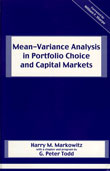
Mean-Variance Analysis in Portfolio Choice and Capital Markets

Caractéristiques
Auteur : Harry M. Markowitz
Titre original : Mean-Variance Analysis in Portfolio Choice and Capital Markets
Publication : 2000 (Première édition en 1987)
Editeur : Frank J. Fabozzi Associates
ISBN : 1-883249-75-9
Nombre de pages : 379
Prix : 44,81 euros
About the Authors
HARRY MARKOWITZ
Dr. Markowitz has applied computer and mathematical techniques to various practical decision making areas. In finance : in an article in 1952 and a book in 1959 he presented "modern portfolio theory," now a standard topic in college courses and widely used by institutional investors for tactical asset allocation, risk control, and attribution analysis. In other areas : Dr. Markowitz developed "sparse matrix" techniques for solving very large mathematical optimization problems, now standard in production software for optimization programs. He also designed and supervised the development of the SIMSCRIPT programming language which have been widely used for programming computer simulations of systems like factories, transportation systems, and communication networks.
In 1989 Dr. Markowitz received The John von Neumann Award from the Operations Research Society of America for his work in portfolio theory, sparse matrix techniques, and SIMSCRIPT. In 1990 he shared The Nobel Prize in Economics for his work on portfolio theory.
G. PETER TODD
Dr. Todd is a Director at Riverview International Group Inc., where he is responsible for software development. From 1990 to 1998 Dr. Todd was a Vice President at Daiwa Securities Trust's Global Portfolio Research Department (GPRD), where he worked with Harry Markowitz, GPRD's Director of Research. Dr. Todd received a Ph.D. in Biochemistry from Cornell University and a B.S. in Chemistry from Utah State University.
Foreword
Harry Markowitz (1952) revolutionized the field of finance with his seminal Journal of Finance paper "Portfolio Selection." (Interestingly, the paper was the last one in the issue.) In it he argued for the explicit recognition of risk and its quantification in terms of variance. He also introduced the notion of a (mean-variance) efficient portfolio as one that (1) provides minimum variance for a given expected return and (2) provides maximum expected return for a given variance. Finally, he provided a preliminary description of the key aspects of one approach for solving what is now termed the "standard" portfolio selection model.
Markowitz (1956) presented an algorithm for solving a more general class of portfolio selection problems. Markowitz (1959) brought all this material together and discussed at some length the basis for concentrating on the mean (expected value) and variance (or standard deviation) of portfolio return when selecting securities.
In recent years, Markowitz has investigated the efficacy of mean-variance analysis when utility fonctions are not quadratic (Levy and Markowitz (1979)), considered special cases involving factors and scenarios (Markowitz and Perold (1981a)), and investigated ways to exploit sparse matrices when solving portfolio selection problems (Markowitz and Perold (1981b)).
Now Markowitz has collected the majority of this material and much more in Mean-Variance Analysis in Portfolio Choice and Capital Markets. Here the reader will find a complete treatment of the most general possible portfolio selection model, efficient solution algorithms, characteristics of possible solutions, aspects of various important special cases, and more.
The exposition follows Markowitz's usual pattern. Practical aspects are introduced first, at a relatively accessible level. Then some fairly heavy mathematical artillery is brought to bear on the subject. This facilitates rigorous proofs of previously known results and generalizations to cover previously unanalyzed cases. The reader who is unable or unwilling to bear the cost of following the more difficult parts of the book will still find much of value, however, for highly readable summary statements are provided throughout.
Markowitz defines the task of portfolio selection as one of finding all efficient E,V combinations that can be provided by portfolios meeting a set of constraints. Thus, all cases covered share an objective function that can be written as
Maximize λEEp-Vp for all λE from +∞ to 0, (1)
where Ep is the expected value and Vp the variance of return on the portfolio.1 Throughout the book, emphasis is placed on the entire set of solutions rather than a particular one.
Thus, no mention is made of the possibility of prespecifying a value of λE (such as an investor's risk tolerance) and then solving for a single portfolio. Instead, the problem is approached in two steps : (1) find all efficient portfolios, then (2) select the one that is best for a given investor. "One-step" solutions can be obtained as special cases of the more general approach covered in the book and are thus analyzed implicitly.
Since Markowitz assumes that all portfolio selection problems have the same objective function, cases are differentiated only by the nature of the constraints that determine the feasible set of portfolios. The most general form can be written as
Ax≥b,
where x is an n-element vector that indicates the proportions invested in the various securities plus (perhaps) auxiliary variables, A is an m by n matrix, and b is an m-element vector. The jth row of A and the corresponding value of b define a constraint of the form :
aj1x1 + aj2x2 + … + ajnxn ≥ bj.
Judicious use of this format allows the inclusion of "less than" inequalities (by reversing all the relevant signs) and equalities (by including two inequalitie that together bound the values to be the same).
Equation (2) defines Markowitz's "Form 1" of the general portfolio selection model. An important special case arises when all the constraints are, in effect, equalities. Here one can write
Ax=b.
Markowitz terms this an affine constraint set. Such a case is extremly important for the development of equilibrium theory, for it allows "two-fund separation" (in Markowitz's terms : one critical line). With such a constraint set, every efficient portfolio can be expressed as a combination of two preselected efficient portfolios. This ensures that the aggregate of all investors' holdings (the "market portfolio") will itself be efficient.Thus, in turn, guarantees that every security will conform to the linear relationship between expected return and beta (measured relative to the market portfolio) of, for example, the Capital Asset Pricing Model.
If the constraint set is not affine (that is, there is one or more inequality constraint), the market portfolio need not be efficient, and simple, economically meaningful relationships between expected returns and beta values need not obtain. Markowitz discusses these relationships at length and provides more general conclusions than were previously available.
The distinction between models with affine constraint sets and those with inequalities is central to both the organization and the focus of this book. Markowitz dichotomizes applications of mean-variance analysis on p. 43 into two groups : money management, in wich "actual portfolios are selected and money allocated, based on mean-variance analysis," and economic analysis, in which "the economy is analyzed assuming all investors seek mean-variance efficiency." More traditional terminology would call the first set normative models and the second positive models.
Portfolio selection problems with affine constraint sets require little effort on the part of a computer programmer. Inversion of a matrix will often suffice. However, problems with inequality constraints can be much more difficult to solve. A quadratic programming algorithm is needed, and special cases may require considerable sophistication.
A survey of recent journal articles with portfolio selection content would surely reveal much more emphasis on models with affine constraint sets than on those with inequality constraints. In this book the emphasis is reversed. While Markowitz maintains an apparently even-handed approach, his practical experience can be discerned in quotation such as this one from pp. 43-44 :
...Surely J. Tobin, W. Sharpe, and J. Lintner knew, as well as you and I know, that if your net worth is
$1,000,000 the bank will not loan you $1,000,000,000. Surely F. Black and J. Mossin knew that if you have
$10,000 at a broker, you cannot short $1,000,000 of security A and use the proceeds plus your own money
to buy $1,010,000 worth of security B, as the Black model allows.
The reason for models incorporating such assumptions is that they imply simple relationships among
interesting economic magnitudes. In chapter 12 we will see that some of the simple relationships implied by
these models also hold for somewhat more general constraints, albeit they do not hold generally.
Markowitz's concern with the most general class of portfolio selection problems is also reflected in the location of material on models for "economic analysis." Portions of the Capital Asset Pricing Model are first introduced in exercises at the end of Chapter 6, but detailed discussion is deferred until the penultimate chapter. This makes great sense since the goal of the book is to enable the reader to truly understand the general case before dealing with the relatively simple special cases that arise with affine constraint sets.
The book is divided into five parts and an Appendix.
Part I introduces the subject, starting with simpler models and then proceeding to the general case. It is by far the most readable and should appeal to all who are interested in the subject.
Part II provides preliminary results. It begins with a chapter containing mathematical material needed for the detailed discussions that follow. Next, properties of both general cases and those with affine constraint sets are derived.
Part III deals with solution procedures. Here the critical line method developed by Markowitz in the 1950s is extended to cover potential problems and the resulting algorithm proven to work, in principle, in all possible cases. (Limitations on numeric accuracy resulting from fixed computer word lengths may, however, cause problems in some applications.)
Part IV introduces the notion of a canonical form for analyzing a portfolio selection problem and then applies it to a discussion of the conditions under which the market portfolio will be efficient.
Part V presents and discusses a computer program for solving the general portfolio selection problem.
The Appendix provides elements of matrix algebra and vector spaces that are used in various parts of the book.
The book is full of gems, many of which occur in unexpected places. It is also contains idiosyncratic behavior. One of the gems is the fascinated "historical note" at the end of Chapter 2. Here, Roy (1952) is given its due although one might reasonably quarrel with Markowitz's overly modest characterization of Markowitz (1952) as "the other paper opening the era of modern portfolio theory" (emphasis added). Among other things, we also learn here that Leavens (1945) proposed variance as a measure of the riskiness of a bond portfolio.
Additional gems are found in Chapter 3. Here, Markowitz's original justification for the mean-variance approach (the use of quadratic approximations to an investor's utility function) is spelled out in detail and a surprinsingly long list of papers measuring its effectiveness cited. Also, a discussion (unfortunately terse) of multiperiod strategies is given, along with a slightly different axiomization of the expected utility maxim from that used in Markowitz (1959).
Idiosyncratic behavior can be found in some places. For example, Markowitz insists that mean-standard deviation and mean-variance diagrams be drawn with expected return on the horizontal axis, although current practice places it on the vertical axis. He provides a valid argument for doing so (based partly on mathematical purity) but thereby imposes added costs on readers familiar with now conventional approaches.
While some discussion of the Lemke and Wolfe quadratic programming algorithms is included, Markowitz deals primarily with the critical line algorithm, wich "provides the whole solution, nothing but the solution, and (in nondegenerate case) the only solution to the portfolio selection problem." No mention is made of the widely used gradient methods, perhaps because they provide only approximate solutions and are not as efficient for parametric programs (that is, with λE varying), which Markowitz defines as portfolio selection problems.
The program in Chapter 13 was originally written in EAS-E, a database management language developed by Markowitz but generally unavailable at this time. In this edition it is written in Visual Basic for Applications, which is less elegant but widely used. This change makes a well-tested algorithm available to many at little or no cost--a major contribution for both teachers and practitionners of investment management.
How much mathematics is required to fully understand this book ? In the Appendix, Markowitz states, "It has been assumed, as a prerequisite to this book, that the reader has had a course in matrix algebra and two semesters of the calculus." To help those who are a bit rusty, however, the Appendix reviews the former and states that only the first-order conditions for maximization of a function are needed from the latter. Perhaps more important than background is a willingness to "pay particular attention to definitions of concepts such as sphere, ball, open set, closed set, and the like" if the formal proofs are to be followed in detail.
Happily, one need not do even this to get a great deal of good from this book. The essence of Chapters 1, 2, 3 and 12 can be gained without much mathematics, and these cover many of the concepts in the book.
Markowitz's early works have suffered the fate of those of other pioneers : often cited, less often read (at least completely). Indeed, in this book he evidences his concern that "many scholars interested in such matters apparently never found [the discussion of fundamentals in the back of the 1959 book]" This book is organized somewhat differently, to better serve those who will read only the earlier chapters.
My advice to the reader whose interests are relatively pragmatic : Don't be frightened by the formal proofs, canonical forms and so on. Read what you can and skip over what you cannot.
No matter what your level of training, if you are seriously interested in investment theory or practice, you will be well rewarded for having purchased this book.
William F. Sharpe
Preface to Revised Reissue
This reissue is identical to the original except for a Foreword by William Sharpe and a new Chapter 13 provided by Peter Todd. The Original Chapter 13 presented a "critical line algorithm" program, for tracing out a complete efficient frontier, writen in EAS-E programming language. (See Markowitz, Malhotra and Pazel (1984).*) The present Chapter 13 is written in VBA (Visual Basic for Applications) for access from EXCEL. The program, presented and described here, is also available from Dr. Todd as noted in his chapter.
Chapter 4 is a stumbling block for some readers. I emphasize the point made in its introduction that "It is not essential for the reader to master every detail of this chapter before moving on to the rest of the book." On the other hand, the reader who has had a course in real or functional analysis will find much of the Chapter redundant. The Chapter was developed for Ph.D. classes whose students mostly had basic courses in matrix algebra and calculus but none in real analysis.
A working knowledge of matrix notation and some results from matrix algebra are prerequisite for this book. These are reviewed in the Appendix. Markowitz (1959) illustrate the ideas presented here for the reader without such background.
The objectives of this book are described in the original Preface and, more completely, in Part I. These need not be repeated here. The original Preface also contains various acknoledgements. What needs to be added here is heartfelt thanks to Franck Fabozzi for suggesting this reissue, to Bill Sharpe for supplying, a Foreword and to Peter Todd for the new Chapter 13. Many thanks also to my secretary, Ruth Sirota. Whenever I received an inquiry about the availability of this book while it was out of print I would send a photocopy to the interested party. I imagine that Ruth is almost as happy as I am at the reissue of this book, since she no longer has to produce small batches of this book on our photocopier from time to time.
Harry Markowitz
San Diego, California
November 1, 1999
* Markowitz, H. M., Malhotra, A., and Pazel, D. P. (1984), "The EAS-E application development system : principles and language summary", Communications of the Association for Computing Machinery, 27(8), August, pp. 247-59
Preface
The principal contents of this book include something old and something new. The something old is what we will refer to as the "General mean-variance model." It seeks mean-variance efficient portfolios subject to any system of linear equality or inequality constraints. It was defined and solved under somewhat restrictive assumptions in Markowitz (1956), and under more general assumptions in Appendix A of Markowitz (1959).
Certain special cases of the general model have become widely known, both in academia and among managers of large institutional portfolios. They are part of the standard contents of any modern financial textbook.
But nowhere is the general solution explained except in terse accounts such as the two cited above. In particular, to my knowledge the existence and characteristics of the general solution are presented in no finance text for students at any level.
It is not that the general solution is without connection to modern financial practice. For example, André Perold's widely used portfolio optimizer allows investment institutions to compute mean-variance efficient sets subject to any system of linear equality or inequality constraints, for very large populations of securities. Part of the efficacy of Perold's code results from exploiting properties of efficient sets as determined by the solution to the general model.
But the solution to the general model is not only a computing procedure. It is a body of propositions and formulas concerning the shapes and properties of mean-variance efficient sets. I believe that these propositions and formulas have implications for financial theory and practice beyond those of the already widely known special cases.
My initial objective in writing this book was to present an accessible account of the general mean-variance analysis. Most of the book still reflects this original intent. Specifically, the first part presents the general model. It illustrates the scope of the model in terms of well-known special cases and kinds of constraints used in practice. It also discusses topics such as the approximation of nonlinear constraints, the relationship between the one-period and the many-period analysis, and the reasons for using mean and variance as criteria.
The second part of the book develops preliminary results to be used in the general analysis. Chapter 4 contains an introductory but rigorous exposition of such mathematics - beyond matrix algebra and elementary calculus - needed for the analysis to follow. The appendix to the book (as opposed to two appendices of individual chapters) summarizes such material on matrix algebra and vector spaces as is required. It is intended for the reader who has had a course on the subject but is a "bit rusty". It is hopped that the arrangement of material in part 2 and the appendix will allow readers of different mathematical backgrounds to find suitable paths through the book.
The third part solves the general model for all possible inputs. Chapters 7 and 8 treat the "easy" case in wich it is assumed, e.g., that a unique portfolio maximizes expected return, and other "nondegeneracy" assumptions. In chapter 9 all such assumptions are removed. (Nonsingularity of the covariance matrix is not required, even in chapters 7 and 8.)
The principal new material appears in chapters 11 and 12 wich comprise part 4. Like the Black and the Sharpe-Lintner Capital Asset Pricing Models (CAPMs), chapter 12 assumes that all investors have the same beliefs and seek mean-variance efficiency subject to the same constraint set. Unlike these CAPMs, chapter 12 explores the implications of more general portfolio selection models for wich certain implications of the Black and the Sharpe-Lintner models still hold ; and also illustrates that these implications do not hold in general.
Chapter 11 presents a "canonical" graphical analysis wich is considerably more powerful than the original graphical methods of Markowitz (1952) and (1959). Canonical graphs can easily be drawn to illustrate various cases, e.g., wherein the set of efficient EV combinations does, or does not, have a kink where two pieces of the set of efficient portfolios join ; where the set of efficient Eσ combinations has a straight line segment at one end or other ; and so on. The means, variances, and covariances of the securities involved can be read from the graph. Exercise 11.4 presents a remarkable possibility which is counter-intuitive in terms of the old graphical method, and easy to construct with the new. Canonical graphs are used in constructing certain CAPM examples in chapter 12.
I find that if one omits purely historical or incidental topics and does not attempt to cover every proof in class, the contents of this book can be taught in a one-semester Ph.D. course on mean-variance analysis. Perhaps professors of finance who must cover some mean-variance analysis in more general investment courses, quantitative analysts in the financial industry who work with inputs to and outputs from portfolio optimizers, and quantitatively oriented consultants to the financial industry may find this book of value for their own background reading.
Some of the exercises at the ends of chapters are purely pedagogical, to emphasize or illustrate material already presented in the chapter. Other exercises present new material of value in itself. In particular, certain classic results in financial litterature - a "two funds" separation theorem, a proof that the market is an efficient portfolio given a certain model, some Elton, Gruber, and Padberg algorithms, and so on - are left to be derived as exercises. In general, extensive "hints" are provided, especially when the assignment is not an easy corollary of more general results presented in the chapter.
Marshall Blume, Richard Cheung, Haim Levy, and William Ziemba have read all or large parts of the manuscript of this book and have made many extremely valuable suggestions. The fact that this particular book was written at this time, or the way certain material was handled, is the result of various conversations, recent and less recent, especially with Nusret Cakici, Lawrence Fisher, Alan Hoffman, André Perold, Joel Segall, William Sharpe, and Ming Wang. Thanks to one of the generous grants to Baruch College by Marvin Speiser, I have been able to pursue my writing and research without need to seek support from the organizations frequently acknowledged at this point in technical books. I am delighted to thank Ms Barbara Gautier who has cheerfully and efficiently typed an unbelievable number of drafts of the chapters herein and, as my administrative assistant, has kept the world neatly arranged for me. Finally, but not the least, I would like to thank the two ladies of my home, Barbara Markowitz and her aunt, Satche Shulkin, now 96, who have been most patient with a housemate heavy-laden with book.
Harry Markowitz
Baruch College
Sommaire
| Foreword | ix | |
| Preface to Revised Reissue | xv | |
| Preface | xvii | |
| Part I The General Portfolio Selection Model | ||
| 1 PORTFOLIO SELECTION MODELS | 3 | |
| The Standard Mean-Variance Portfolio Selection | 3 | |
| Standard Analysis with Upper Bounds | 7 | |
| The Tobbin-Sharpe-Lintner Model | 8 | |
| Black's Model | 11 | |
| Model Requiring Collateral for Short Positions | 11 | |
| Nominal versus Real Returns | 13 | |
| Appendix to chapter 1 | 15 | |
| Mean and variance of weighted sums | 15 | |
| General sample spaces | 20 | |
| Exercises | 20 | |
| 2 THE GENERAL MEAN-VARIANCE PORTFOLIO SELECTION MODEL | 23 | |
| Three Forms of the General Model | 24 | |
| Nonlinear Examples | 28 | |
| Historical Note | 36 | |
| Exercises | 40 | |
| 3 CAPABILITIES AND ASSUMPTIONS OF THE GENERAL MODEL | 42 | |
| Semidefinite Covariance Matrices | 42 | |
| Portfolio Constraints in Theory and Practice | 43 | |
| Industry Constraints | 44 | |
| Models of Covariance | 45 | |
| Exogenous Assets | 48 | |
| Tracking an Index | 50 | |
| Turnover Constraints | 51 | |
| Why Mean and Variance ? | 52 | |
| Bayesian Inference | 56 | |
| Implied Single-period Utility Maximization | 57 | |
| Quadratic Approximations | 59 | |
| Research on EV Approximations | 63 | |
| Related Matters | 68 | |
| Part II Preliminary Results | ||
| 4 PROPERTIES OF FEASIBLE PORTFOLIO SETS | 73 | |
| Notation | 74 | |
| The Limit of a Sequence | 77 | |
| Convergence in Rn | 80 | |
| Closed Sets | 80 | |
| Spheres, Balls, and Open Sets | 82 | |
| Compact Sets | 86 | |
| Convex Sets | 89 | |
| Unbounded Constraint Sets | 92 | |
| Disallowed Directions and Bounded Feasible Directions | 94 | |
| Conical Sets | 98 | |
| Appendix to chapter 4 | 100 | |
| Exercises | 105 | |
| 5 SETS INVOLVING MEAN, VARIANCE, AND STANDARD DEVIATION | 107 | |
| Relationships Involving E | 107 | |
| Relationships Involving V | 109 | |
| Compensating Transformations | 113 | |
| V along a Straight Line | 114 | |
| σ along a Straight Line | 116 | |
| Convex Functions | 117 | |
| Minimum Obtainable V and σ | 120 | |
| Exercises | 122 | |
| 6 PORTFOLIO SELECTION MODELS WITH AFFINE CONSTRAINTS SETS | 125 | |
| Minimization Subject to Constraints | 125 | |
| Efficient Portfolios with Affine Constraint Sets | 127 | |
| Postscript | 139 | |
| Exercises | 143 | |
| Part III Solution to the General Portfolio Selection Model | ||
| 7 EFFICIENT SETS FOR NONDEGENERATE MODELS | 151 | |
| Kuhn-Tucker Conditions | 152 | |
| Critical Lines | 154 | |
| Efficient Segments | 157 | |
| Adjacent Efficient Segments | 161 | |
| The Nonsingularity of M | 166 | |
| Nonnegativity of X and η | 171 | |
| Finiteness of the Critical Line Algorithm | 174 | |
| The Efficient EV Set | 176 | |
| Choice of Axes | 178 | |
| Exercises | 179 | |
| 8 GETTING STARTED | 151 | |
| The Simplex Method of Linear Programming | 185 | |
| Prices and Profitabilities | 191 | |
| Starting the Critical Line Algorithm | 193 | |
| Exercises | 195 | |
| 9 DEGENERATE CASES | 199 | |
| Simpler "Good Enough" Methods | 200 | |
| Efficient Sets when E is Bounded | 202 | |
| Lexicographical Ordering | 214 | |
| Unbounded E | 216 | |
| Related Matters | 219 | |
| Exercises | 223 | |
| 10 ALL FEASIBLE MEAN-VARIANCE COMBINATIONS | 225 | |
| The Top of the Obtainable EV Set | 229 | |
| Comparison of the Top and Bottom of the EV Set | 236 | |
| The Sides of the Feasible EV Set | 238 | |
| Exercises | 239 | |
| Part IV Special Cases | ||
| 11 CANONICAL FORM OF THE TWO-DIMENSIONAL ANALYSIS | 243 | |
| The Standard Three-security Analysis | 244 | |
| Canonical Form when Rank is 2 | 248 | |
| Efficient Sets in the Canonical Analysis (Rank 2) | 253 | |
| Kinks in the Set of Efficient EV Combinations | 257 | |
| Linear Segments in the Set of Efficient Eσ Combinations | 259 | |
| τ* of Rank 1 | 262 | |
| The k Dimensional Canonical Analysis | 265 | |
| Appendix to chapter 11 | 270 | |
| Exercises | 272 | |
| 12 CANONICAL CONSTRAINT SETS AND THE EFFICIENCY OF THE MARKET PORTFOLIO | 275 | |
| The Market Portfolio | 276 | |
| Conical Constraint Sets | 277 | |
| Efficiency of the Market Portfolio | 280 | |
| A Simple Market Equilibrium Model | 282 | |
| How Inefficient can the Market Portfolio Be ? | 284 | |
| Expected Returns and Betas | 286 | |
| Exercises | 288 | |
| Part V A Portfolio Selection Program | ||
| 13 PROGRAM DESCRIPTION (BY G. PETER TODD) | 301 | |
| Notation | 302 | |
| Statement of the Problem | 303 | |
| Program Inputs | 304 | |
| The Main Module | 305 | |
| The Simplex Method | 306 | |
| The Critical Line Algorithm | 312 | |
| Appendix A to Chapter 13 : Program Listing | 318 | |
| Appendix B to Chapter 13 : Integration with Spreadsheet | 334 | |
| Appendix C to Chapter 13 : Sample Problem | 335 | |
| APPENDIX ELEMENTS OF MATRIX ALGEBRA AND VECTOR SPACES | 339 | |
| Mathematical Prerequisites | 339 | |
| Uses of Matrix Notation | 339 | |
| Matrix Operations | 341 | |
| Inverses | 343 | |
| Substitution of Variables | 344 | |
| n Dimensional Geometry | 346 | |
| Orthogonality | 348 | |
| Independance and Subspaces | 348 | |
| Change of Coordinate Systems | 350 | |
| Change of Coordinates in Rn | 357 | |
| References | 361 | |
| Index | 367 | |
Acheter ce livre
Acheter le livre 'Mean-Variance Analysis in Portfolio Choice and Capital Markets' sur Amazon.
Haut de la page Bibliographie Itinéraire de lectures Sommaire du site
Rubriques
Meilleurs courtiers en Bourse
Meilleurs PEA
Toutes les données du CAC40
Livres finance et Bourse
Newsletter
Pour recevoir nos derniers articles, détachements de dividendes et offres de placements :
Nous contacter ou nous suivre sur les réseaux
Site hébergé par OVH - 2 rue Kellermann - 59100 Roubaix - France - Tel : 09 72 10 10 10